Choosing bangs for face shape works best when the shape is one observation among several. The same fringe can sit smoothly on one hairline and split on another, while a few millimetres of length can decide whether it clears your glasses. Before cutting, compare the line you want across the forehead with your hair’s natural direction, texture and the attention you are prepared to give it.
Start with hairline, density and daily effort
Look at the front of your hair after an ordinary wash, before forcing it into a style. Does it fall forward, open at the centre or sweep firmly to one side? A cowlick near the hairline may lift a short section or make a part reappear. Show that behaviour to the stylist rather than arriving with it hidden under a carefully smoothed finish.
Consider how much hair is available for the fringe. A thick-looking reference may use a deeper section than you want to take from the rest of your cut. Fine strands can still make a useful fringe, but a wide or dense design may affect how full the sides look. Ask where the section will start and how it will connect with the hair beside your face.
Be clear about your morning limit. A fringe that needs dampening and drying into place can be reasonable if you enjoy that step. It can be frustrating if you normally leave wet hair to dry untouched. Include days when you exercise, wear a helmet or pull your hair back: the front section will still be there even when the rest is tied up.
Texture changes the choice as well. A straight fringe cut into wavy hair may not keep a straight edge without styling. Curly bangs can be lovely in their natural pattern, but their dry length and grouping need to be considered. Bring a picture of your own air-dried hair, so the conversation is about your routine as well as an inspiring image.
Compare curtain, side swept and straight fringes
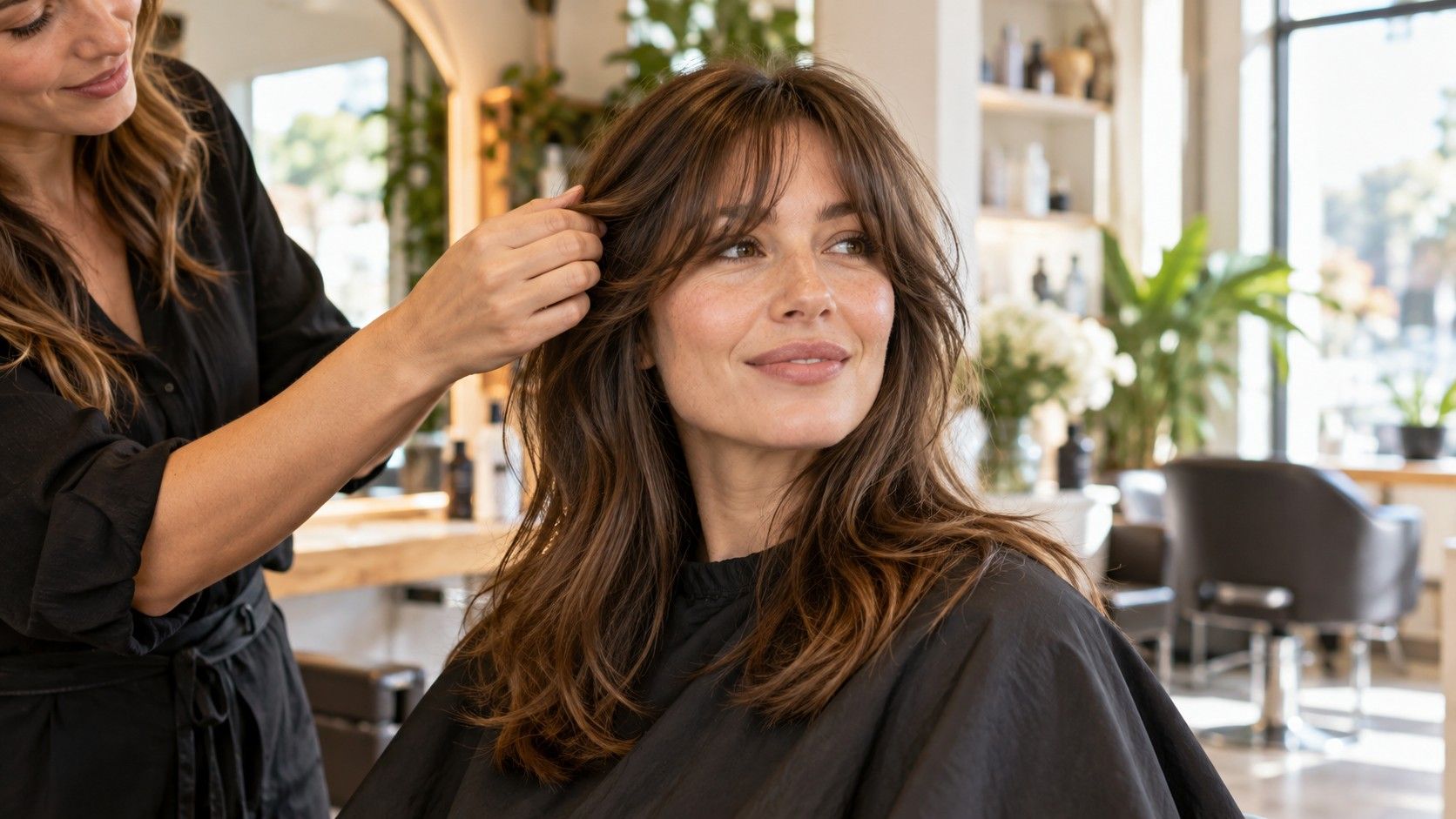
Curtain bangs part around the centre and usually become longer toward the sides. The central opening leaves some forehead visible, while the outer pieces frame the temples or cheeks. They may offer room to sweep the hair away, but the name does not guarantee effortless styling. A front section that refuses to part centrally may need regular persuasion.
A side-swept fringe draws a diagonal line across the forehead. It can be light and loose or more substantial, and it often works with an existing directional fall. Check which side feels natural before choosing a reference. A fringe repeatedly pushed the wrong way may spring back, especially when the hair becomes damp or the style loses hold.
A straight fringe gives a clearer edge, whether the ends are blunt or more broken up. The result depends on width, density and length: a narrow light fringe is a different decision from a broad heavy one. If you like a strong graphic line, say so. There is no reason to soften every angular face or avoid a clear edge on a rounded one.
| Style | Line across the face | Question before cutting |
|---|---|---|
| Curtain | Open centre and longer outer pieces | How will it sit with your natural part? |
| Side swept | Diagonal movement | Can you sweep it aside comfortably? |
| Straight | A more continuous horizontal edge | Where will it fall dry, including above your glasses? |
Use these distinctions to compare options, not to select a winning category. You can ask for a lighter version of a straight fringe or a less pronounced curtain shape. A reference photograph shows one combination of cut and styling; it does not lock you into every detail.
Adjust width and length for your proportions
Instead of looking for a single fringe for face shapes, look at what area you want to frame. A wider fringe exposes a different amount of temple and side hair from a narrow one. Longer outer pieces can connect the forehead area to the cheeks. The shape of that connection may matter more to you than whether a chart calls your face oval or heart-shaped.
Compare the effect of covering more forehead with leaving an opening. On a longer-looking face, some people enjoy a fuller line that reduces the visible forehead area. Others prefer an open centre and the vertical impression it preserves. On a compact face, either can also work. Decide from the complete hairstyle and your preference, rather than assuming every face needs visual correction.
Length needs a practical checkpoint. A fringe near the lashes may look good in a still image but become distracting while reading or walking in wind. Glasses can lift the ends or catch individual hairs. Wear your usual frames during the consultation and check the front from a normal head position, not with your chin raised to keep it clear.
Look at the side view too. A deep fringe section changes the amount of hair travelling forward and can affect the outline above the forehead. Ask how the front will blend when you tuck the sides behind your ears. If you use a strong side part, decide whether you want to keep it before the section is cut.
Try a temporary fringe without trusting it blindly
A clip-in fringe can help you preview forehead coverage and the broad position of a line near the eyes. Match the colour and texture reasonably closely, then adjust it slowly in front of a mirror. Check it with your hair down, tied back and with glasses. Take photographs from the same distance so a camera-angle change does not become the deciding factor.
Pinned hair can offer another rough preview. Bring a section forward and secure it without pulling tightly at the roots. You are testing where a line falls, not proving how freshly cut strands will behave. Long hair folded into place carries different weight, and a clip-in may have a different density or direction from your natural front section.
Digital filters are less useful for assessing feasibility. They can show a general silhouette but may quietly change the hairline, smooth the texture or adjust facial proportions. Keep the original image beside the preview. If you like the result, identify the specific feature you like and discuss whether your own hair can produce it.
Give the preview more than one glance. Notice whether you keep moving the hair away, whether the eyes feel obscured or whether you prefer it after a small shift in width. Those reactions are useful. You do not need to decide that the experiment looks universally better; it only needs to help you say what you want and what would bother you.
Agree on a first cut that leaves room to adjust
Bring a small set of references and explain one useful detail in each. “This amount of forehead coverage, with these longer side pieces” is clearer than asking for a celebrity’s bangs. Include an example you dislike and explain why: too dense, too short, too round at the sides. Keep the discussion focused on the cut rather than whether you resemble the person in the picture.
Ask the stylist to explain the proposed dry length, width and section depth before cutting. Leaving a little length for refinement may make sense, but an excessively long first cut can hide how the intended shape will sit. Agree on a cautious starting point that can still be assessed, particularly for curls or a front section with strong lift.
Once the hair is dry, move your head naturally and put your glasses on. Look at the fringe after it has been brushed aside and released. If you will normally air-dry, ask how to judge it without a polished salon finish. Mention any section that falls into your eyes or separates in an unexpected place before making a further adjustment.
Finish with the grow-out plan. Ask how the shortest pieces will blend into the sides and which styling changes will help when they become longer. Decide whether you are willing to book fringe trims or prefer a shape with a more flexible length. The best bangs for your face shape are a workable combination of proportion, hair behaviour and preference, not a permanent label attached to your forehead.