Round and oval faces can share soft cheeks and a rounded chin, so a quick selfie often leaves the question unresolved. The useful difference is usually in the overall length and the way the sides narrow toward the jaw. Here is a way to compare those features without turning one photograph, one measurement or a styling suggestion into a fixed rule.
Look at length before cheek fullness
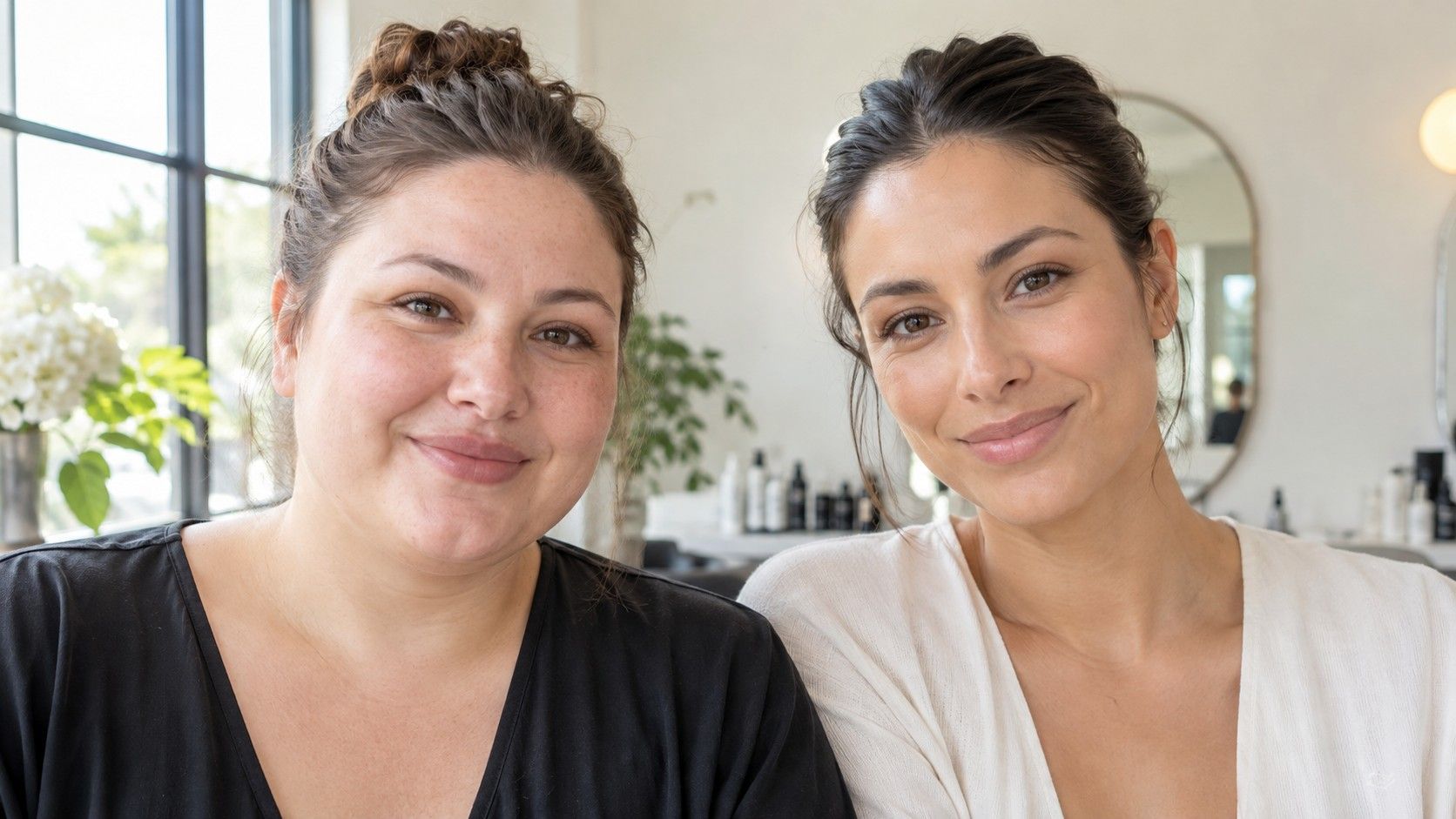
A round face tends to read as relatively compact, with a softly curved perimeter. An oval face usually reads as longer, with width easing toward the chin. Those are descriptions of the whole outline. Full cheeks can appear in either group, and a slim face can still look round. Start by ignoring the word round as a description of body size; it is a shorthand for proportions.
Pull the hair away from the temples and look straight ahead in a mirror. Find the broadest part of the cheeks, then follow the face from the upper forehead to the bottom of the chin. Does the outline feel noticeably stretched vertically, or does its width occupy much of the same visual space? Make that comparison before deciding whether your cheeks look soft. A smile changes the cheek outline, so use a relaxed expression for this first look.
If you want measurements, record face length and cheekbone width using the same method each time. Treat the numbers as a check on what you see, not a threshold that assigns an identity. A ruler held in front of a face, a tape following its curves and a measurement on a photograph are different methods. Mixing them can create a precise-looking result that answers very little.
There is no need to settle the label in one sitting. Write down “soft outline, slightly longer than wide” if that describes the evidence. That phrase is already useful when comparing a fringe, glasses or a hairstyle. It gives you something observable to test, while a forced choice between two labels can make every styling suggestion feel contradictory.
Compare the jaw and side outline
Next, trace the outside edge from temple to jaw without following the hair. On a round outline, the cheeks and lower face often form a continuous broad curve. On an oval outline, the sides commonly narrow more gradually toward a rounded chin. Neither needs a pointed chin, and a rounded chin alone cannot separate them. Look at the transition around it.
Check both sides. Small differences between the left and right are ordinary, and light from a nearby window can make one jaw edge appear sharper. If one side suggests oval and the other seems round, face the light more evenly before drawing a conclusion. A dark shadow beneath a cheek is not a measurement of cheekbone width.
A useful comparison keeps each observation separate. The table below is a prompt for looking, rather than a scoring sheet. Several oval features with a compact lower face may simply mean that you sit between familiar categories. You do not need to count rows and declare a winner.
| What to compare | Often reads as round | Often reads as oval |
|---|---|---|
| Overall outline | Compact and broadly curved | Visibly longer with a gentle taper |
| Sides below cheeks | A broad continuous curve | A gradual narrowing toward the chin |
| Useful caution | Full cheeks do not establish the shape | A long hairstyle does not establish the shape |
Avoid mistakes caused by lens distance and hair
A close selfie is a poor place to resolve round vs oval face questions. Camera distance changes perspective, and the nearest features can look larger in relation to the sides of the face. Move the camera farther away, use a timer and crop afterward if needed. Keep it near eye level, with your head facing forward rather than tilted down toward the screen.
Take the photograph with an ordinary camera mode and leave face reshaping filters off. Do not compare a wide-angle close-up with a distant portrait and assume your face has changed. For a repeatable comparison, keep the distance, head position and expression similar. The aim is a reasonably neutral view, not a technically perfect studio photograph.
Hair creates a second outline. A thick curtain of hair across the temples may hide the broadest point; a tall bun can make the whole silhouette look longer. Take one image with the hair pulled back and another with your usual style. The first helps describe the visible face. The second shows the impression people actually see when you wear that hairstyle.
Beards, sideburns and makeup can alter that impression too. Note where the real jaw edge disappears rather than guessing through a dense beard. When a hairstyle conceals the forehead, leave forehead width as uncertain. An honest missing observation is more useful than a confident number inferred from hair.
Test styling ideas when you sit between both
If you are deciding whether you have a round or oval face shape to choose a haircut, begin with the effect you want. Perhaps you like more visible cheekbones, a softer frame around the eyes or a shorter morning routine. These are different goals. A cut that changes the outline in a photograph may still be inconvenient with your growth pattern or natural texture.
Try small reversible changes before choosing a large cut. Move your part, tuck one side behind an ear, or pin back the front to compare how much forehead you like showing. Photograph each version from the same distance. Watch the hair around cheek level as well as the crown: both influence the overall impression, and extra height is not automatically an improvement.
For glasses, compare actual frames of similar fit before judging the effect of shape. A softly rectangular frame can create a different line from a round frame, but lens size, bridge position and frame width can matter just as much. If a pair slides down or touches your cheeks when you smile, a flattering outline will not make it comfortable.
Keep the experiment personal. You might prefer a round frame because it echoes your features, or a more angular one because you enjoy the contrast. You might like the compact impression of a bob without wanting to make your face seem longer. A face-shape guide should help you name those preferences, not turn them into errors.
Describe your face clearly to a stylist
Bring two or three reference pictures with a specific reason for each. “I like the length here, but not the amount of hair over the eyes” gives a stylist a clearer starting point than “give me a haircut for an oval face.” Include a photograph of your hair on an ordinary day so the conversation begins with its real texture and density.
Say what you noticed about your proportions: the cheeks are the broadest area, the jaw is softly curved, or the face looks a little longer with the hair pulled back. Then explain the practical limit. You may air-dry, wear glasses all day, need to tie the hair back, or dislike frequent fringe trims. Those details help turn a broad visual idea into a workable cut.
Ask where the shortest pieces will fall when dry and how the outline will change as the cut grows. A cheek-level layer on one person can land differently on another, and a styled reference image may hide daily upkeep. Discuss what the shape will look like without a blow-dry, especially if that is how you usually wear it.
When the label stays uncertain, keep it uncertain. “Between round and oval, with soft sides” is an adequate description. The useful result is a style you can evaluate and live with, not a certificate naming your face. Once you can separate face length, cheek width and the effect of your hair, you have enough information to make the next choice.